
 Italiano
 Português
 Amazon
 Ebay
Ebay
Aluminum Ring VS. Plastic Collar Packaging Comparison
⚡️ Introduction
In the world of cosmetic packaging, the dropper bottle’s body often occupies the majority of design attention—the glass must be thick, transparent, and uniquely shaped. However, the dropper bottle’s cap, playing a crucial role in connecting the bottle body to the dropper tip, is the focus of both the consumer’s gaze and their tactile experience every time they use the product.
Currently, the mainstream dropper bottle cap materials on the market are divided into two types: anodized aluminum caps and plastic caps. Both can functionally fulfill the basic tasks of sealing and connection. This article will move beyond simple good/bad judgments and compare the two materials from different perspectives.
⚡️ A First Impression: Differences in Texture at the Visual Level
Humans are visual creatures. Studies show that consumers form an initial judgment about a brand’s positioning within the first seven seconds of contacting a product, and the quality of the packaging contributes over 60% of that judgment in those seven seconds.
1. Electroplated Aluminum Rings: Mirror Finish and Premium Feel
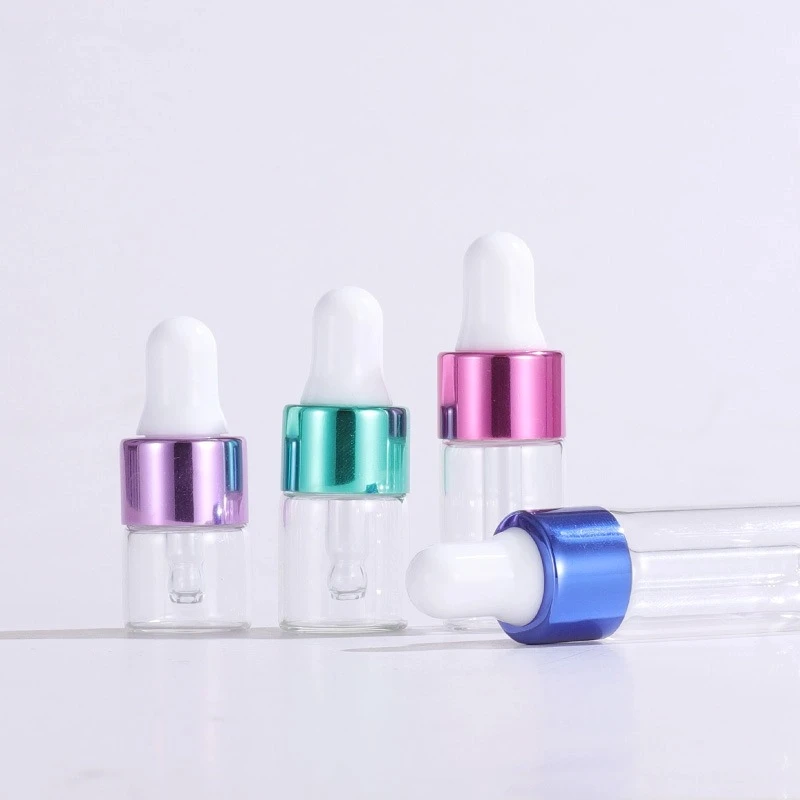
Electroplated aluminum rings utilize a vacuum electroplating process to deposit an extremely thin layer of high-purity metal film on the surface of an aluminum substrate. This process gives the aluminum rings a unique mirror-like metallic luster—the reflection and refraction of light by the metal itself.
This luster is characterized by several visual features:
-
- Sharp Highlights: Under light, the electroplated aluminum ring produces clear, focused highlights.
- Extremely High Color Saturation: Regardless of the color, the electroplated layer exhibits depth and layering, avoiding a superficial appearance.
- High Edge Refinement: Due to the ease of precision machining of aluminum, the threads, cut edges, and transition curves of the electroplated aluminum ring can be clean and crisp, without the burrs or parting lines commonly found in plastic rings.、
2. Plastic Rings: A Pragmatic Choice
Plastic rings are typically injection molded from ABS or PP. Their visual characteristics contrast sharply with electroplated aluminum rings:
-
- Limited Gloss: Plastic rings usually have a “plastic” sheen (easily appearing cheap) or an intentionally matte finish (reducing reflection but struggling to achieve a premium look);
- Limited Color Expression: The “weight” and “depth” of plastic colors can never match that of electroplated metal;
- Visible Manufacturing Marks: Injection-molded plastic rings almost always have parting lines, which can be seen upon close inspection of the threads or the edge of the ring.
⚡️ Psychological Experience when Holding
If sight is the first impression, then touch is the deeper factor determining whether one is willing to continue using it.
1. The Coolness and Weight of the Anodized Aluminum Ring
Aluminum is a metal with excellent thermal conductivity. When you pick up an anodized aluminum ring dropper bottle, the first thing you feel is a cool, metallic touch.
More importantly, there’s the sense of weight. Although aluminum’s density is much lower than steel or copper, it’s still significantly higher than plastic. This means that an aluminum ring of the same volume will be about 2.5 times heavier than a plastic ring.
2. The Gentleness and Lightness of the Plastic Ring
The feel of the plastic ring tells a different story. It feels light, gentle, and non-aggressive when held. For some consumers, this “lightness” signifies convenience and everyday use; but for others, it might be interpreted as “thin” or “cheap.”
⚡️ Durability and Aging Performance
Cosmetic packaging is not disposable; it needs to survive in the hands of consumers for months or even over a year. During this time frame, the differences in performance between electroplated aluminum rings and plastic rings become apparent.
1. The Durability Advantage of Electroplated Aluminum Rings
The durability of electroplated aluminum rings is based on two aspects:
-
- Structural Stability: Aluminum itself has excellent corrosion resistance (a dense protective film of aluminum oxide naturally forms on its surface), and it will not chemically react upon contact with skincare products. Under normal room temperature conditions, electroplated aluminum rings can remain unchanged for years without deformation or fading.
- Adhesion of the Electroplating Layer: A high-quality vacuum electroplating process allows the metal layer to form a strong mechanical and chemical bond with the aluminum substrate. Under normal use, the electroplating layer rarely peels or bubbles. If consumers frequently wipe the ring opening, or if the bottle is placed in a cosmetic bag with hard objects such as keys, minor scratches may appear on the electroplating layer.
2. Aging Signs on Plastic Rings
The aging of plastic rings is a relatively slow but irreversible process:
-
- UV Aging: ABS plastic is sensitive to ultraviolet light. Prolonged exposure to sunlight or strong artificial light can cause plastic bead rings to yellow.
- Stress cracking: The butadiene component in ABS may experience environmental stress cracking when in prolonged contact with certain cosmetic solvents. This manifests as fine cracks on the plastic surface, and in severe cases, breakage along the parting line.
- Surface wear: Plastic is much less hard than metal, and after long-term use, whitish wear marks are likely to appear at the threads and bead edges.
- Chemical migration: Low-quality plastic bead rings may have plasticizer migration issues. Although food-grade and cosmetic-grade plastics have strict controls on this, the risk still exists under high-temperature environments.
⚡️ Chemical Stability and Compatibility of Contents
The rim of a dropper bottle is not merely a decorative element; it directly participates in the sealing system, sharing the same microenvironment as the contents. Therefore, the chemical stability of the material is a crucial safety issue that cannot be ignored.
1. Anodized Aluminum Ring: An Inert Barrier
Aluminum is a moderately reactive metal in the activity series, but due to the easy formation of a dense alumina protective film on its surface, it exhibits extremely high chemical inertness in everyday cosmetic environments. The alumina film has good resistance to acids, alkalis, and organic solvents. (The only areas requiring caution are strongly alkaline environments (such as some makeup removers or cleansing products, pH > 9) and strongly oxidizing ingredients (such as high concentrations of benzoyl peroxide), but these ingredients are generally not packaged in dropper bottles.)
2. Plastic Collar: Solvent-Sensitive
The chemical stability of ABS plastic is relatively complex. While it exhibits good resistance to water, alcohols (at low concentrations), and mineral oils, it is sensitive to high concentrations of essential oils or alcohol, as well as strongly polar solvents.
PP plastic offers superior chemical stability compared to ABS, demonstrating greater resistance to oils and solvents. However, PP has lower rigidity; consequently, for components requiring precise threading—such as the collar of a dropper bottle—its dimensional accuracy is often inferior to that of ABS, making it prone to sealing issues.
⚡️ Environmental Protection and Sustainability
As global consumer interest in sustainable packaging grows, the environmental performance of metallized aluminum collars and plastic collars warrants an objective assessment.
1. Metallized Aluminum Collars: Recyclable but Requiring Separation
Aluminum products can be recycled almost indefinitely without loss of performance, and the energy consumption for recycling aluminum is only 5% of that required for primary aluminum production. The recycling process for metallized aluminum collars is relatively straightforward: once consumers separate the collar from the glass bottle, it can enter the metal recycling stream.
The metal materials used in vacuum metallization may require additional processing during the recycling and smelting stages. However, compared to other applications in the electroplating industry, the plating layer on dropper bottle collars is extremely thin, resulting in a negligible overall environmental impact.
2. Plastic Collars: A Pragmatic Choice Amidst Recycling Challenges
The environmental issues surrounding plastics are more complex. Although ABS and PP are theoretically recyclable, they face several practical obstacles:
-
- Color Contamination: Plastic collars dyed in specific colors are difficult to mix with plastics of other colors during recycling, thereby reducing the value of the recycled material;
- Consumer Sorting Habits: Most consumers do not remove small plastic collars from glass bottles for separate sorting; consequently, they are often discarded as mixed waste and sent to landfills;
- Microplastic Risks: Plastic collars may shed microplastic particles due to wear and tear during use.
⚡️ Conclusion
The choice between an anodized aluminum ring and a plastic ring is, at its core, a choice regarding brand attitude. There is no standard answer; consumers are never merely purchasing a product—they are buying a promise concerning quality and aesthetics.
Last Updated: 2026/07/28

 English
  Italian