
 Italiano
 Português
 Amazon
 Ebay
Ebay
How Multi-capacity Dropper Bottles Build Complete Product Line?
🌹 Introduction
In recent years, dropper bottles have consistently ranked among the top-grossing categories in skincare packaging trends. As brands expand from a single blockbuster product to a complete product line, can the packaging system grow in tandem with the product matrix? If each new product launch requires re-molding, redesigning, and adapting accessories, not only will the development cycle be lengthened, but the brand’s visual identity will also easily become fragmented and cluttered.
This is precisely where the value of multi-capacity dropper bottles lies: they are more than just containers—within a unified aesthetic framework, they provide a flexible yet consistent solution for products with different functions and price points, allowing the brand to maintain a clearly recognizable “family face” as it expands.
🌹 How to Match Multi-capacity Dropper Bottles with Different Product Positioning
1. Common Sizes and Applicable Scenarios
5ml-10ml – Lowering the Decision-Making Barrier
-
- 5ml and 10ml sizes are typically offered as samples, travel sizes, or trial sizes. Smaller sizes mean lower-cost trial and error, and the lower unit price makes consumers more willing to take the first step.
- This size is also suitable for “UGC trial activities” on e-commerce platforms or membership gift scenarios, serving as an effective tool for brand acquisition and word-of-mouth marketing.
15ml-20ml – Establishing a Usage Habit
-
- 15ml-20ml covers a complete skincare cycle, enough for consumers to establish a regular usage habit and observe the product’s effects. Once users have completed the course and are satisfied with the results, they will naturally enter a repurchase cycle.
30ml-50ml – Deep Retention
-
- The larger capacity version targets the brand’s core loyal customers. The core consumer psychology behind these two sizes lies in “value for money”—although the price per bottle is higher, users will find that the price per milliliter is lower than the smaller sizes after calculation.
- The larger capacity not only increases the average order value, but more importantly, it locks in the user’s long-term usage cycle, extending the brand’s customer lifetime value.
2. The Product Line Logic Behind the Capacity Differences
The difference between 1ml and 100ml is not simply a matter of size, but rather a strategic vehicle for the brand’s tiered product line operations. These three sizes form a complete user conversion funnel.
The consistent application across different capacities maintains a unified brand identity visually. From initial experience to repeat purchases and stockpiling, consumers are consistently presented with the same aesthetic language, continuously reinforcing the leather label’s brand identity with each interaction.
🌹 Visual Unity + Functional Differentiation
1. Unique Bottle Shape, Multiple Sizes
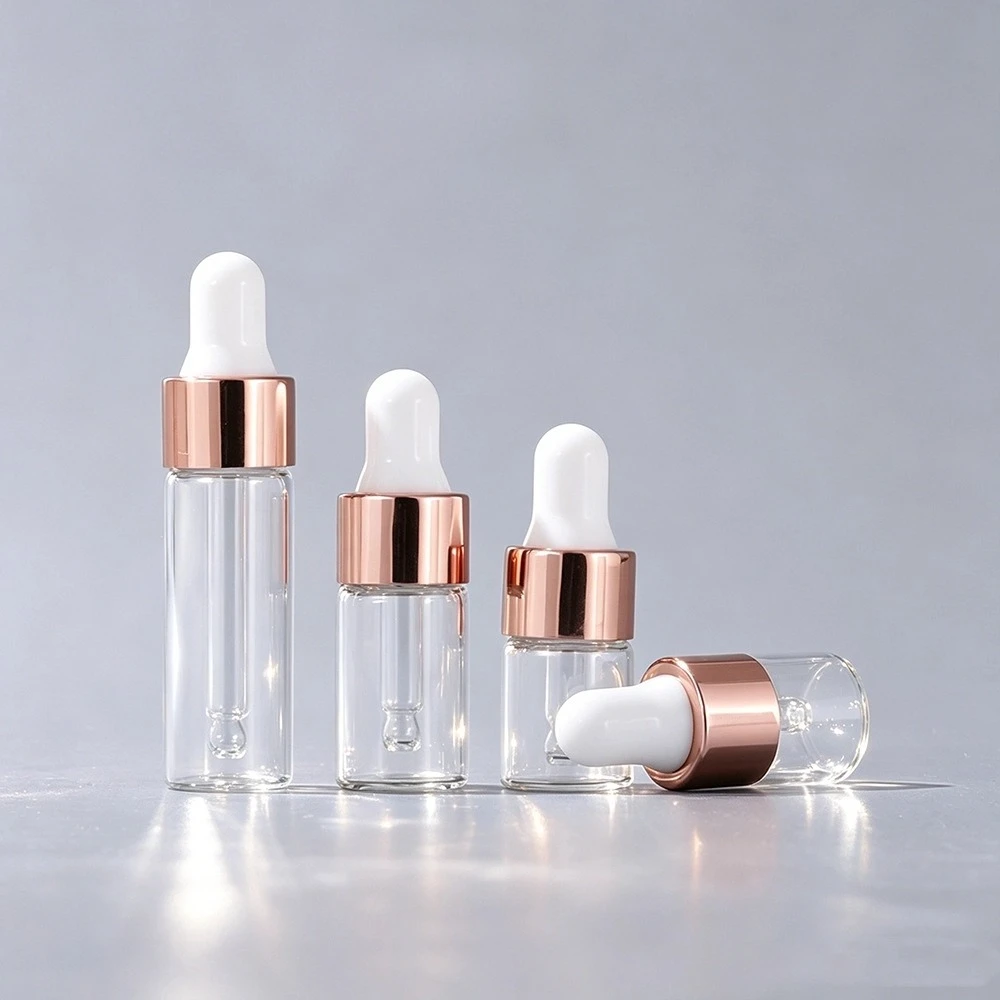
Using a standardized dropper bottle shape with proportional scaling is the core technique for a multi-capacity family design. Maintaining a high degree of consistency in the bottle’s curves, neck proportions, and the placement of the rose gold ring across different capacities creates a visually recognizable silhouette.
When products of different capacities appear in an array on social media and e-commerce product detail pages, the visual repetition and progression further reinforce the brand’s sense of order and professionalism.
2. Differentiated Details: How to Differentiate Within Unity
Brands need to leverage subtle differences to differentiate their product lines. Bottle color is the most direct means of differentiation.
-
- For highly active ingredients, brands can choose light-blocking glass, replacing the transparent glass bottle body with a light-blocking material on top of the rose gold ring transparent glass dropper bottle.
- For basic moisturizing or soothing products with high stability, transparent glass can continue to be used, allowing the natural color of the ingredient to become part of the product’s visual language.
Using the same bottle shape and the same metal ring, the functional stratification of the product line is achieved through differences in the light transmittance of the glass itself, resulting in both unity and clarity.
3. Consistency of User Experience
Multi-capacity products from the same brand and using the same dropper bottle should ensure identical opening and closing feel (damping feel of the cap), identical dispensing method (force feedback when squeezing the rubber tip), and identical single drop volume (so that users can switch between different capacity products without having to readjust their dosage habits).
🌹 Supply Chain and Cost Optimization
1. Significantly Reduced Mold Costs
The core advantage of multi-capacity dropper bottles in the supply chain lies in the standardized design of their components. While the height and neck of the bottles vary depending on the capacity, the thread diameter of the bottle neck is usually consistent. Brands only need to develop one set of bottle body molds, which can be scaled proportionally to obtain versions of the entire range of capacities, eliminating the need for separate molds for each capacity. This substantial reduction in mold costs represents a considerable cost saving for startups and mid-sized brands with a multi-SKU portfolio.
2. Negotiation Advantages of Bulk Purchasing
When brands combine multiple bottle sizes (5ml, 10ml, 15ml, 30ml, etc.) into a single purchase order, the overall purchase volume increases dramatically, naturally leading to a significant increase in negotiation power with packaging suppliers. Suppliers are also more inclined to offer better average unit prices for large-volume, long-term orders.
3. Flexible Market Testing, Reduced Trial-and-Error Costs
The most ingenious application of a multi-capacity strategy lies in the “lightweight launch” path for new product releases. When launching a new product, brands can initially release a small-capacity version, coupled with trial-size pricing or membership trial activities, to quickly gather market feedback and repeat purchase data.
-
- If the product’s effectiveness and formula are validated by the market, the brand can quickly initiate a large-capacity production plan, utilizing proven bottle design molds and universal accessories to replenish and stock medium-to-high-capacity products in a short period.
- If the market response is less than expected, the brand only needs to digest a small batch of inventory, with manageable losses, avoiding the financial pressure and inventory backlog risks associated with large-scale stockpiling.
🌹 Common Misconceptions and Tips for Avoiding Pitfalls
Myth 1: Using the same dropper tip for all sizes. Different bottle heights require dropper lengths. Using the same dropper for all sizes might result in droppers that are too long and touch the bottom of the bottle for small sizes, or too short and fail to collect the remaining liquid at the bottom for large sizes, severely impacting the user experience.
Myth 2: Unreasonable range in bottle size, creating gaps in product offerings, or a lack of price anchoring for consumers between “trial use” and “stockpiling,” affecting conversion rates.
Myth 3: Neglecting compatibility testing between bottle material and contents. Glass dropper bottles and PET/PE bottles have different effects on the stability of the contents. Some active ingredients may react with certain plastics. Thorough compatibility and sealing tests must be conducted with packaging suppliers before mass production.
🌹 Conclusion
Multi-capacity dropper bottles help brands achieve a unified family identity visually, optimize procurement and inventory costs in the supply chain, cover the entire consumer lifecycle from new customers to loyal fans in the market, and provide flexible room for experimentation in product iteration.
It is recommended that brands, when planning their next new product, not just think about “how to make this bottle,” but simultaneously plan “who will sell the different capacity versions to”—from day one, approach each product with a product line mindset.
Last Updated: 2026/07/03

 English
  Italian