
 Italiano
 Português
 Amazon
 Ebay
Ebay
Frosted vs. Clear Glass Dropper Bottles: Which Is Better?
🌱 Introduction
Skincare packaging has long transcended mere protective functionality; as the standard format for high-value products, the appearance of a dropper bottle directly influences consumer trust, value perception, and the willingness to purchase.
Currently, frosted glass and clear glass dropper bottles represent the two mainstream choices. While both have their respective proponents, the choice between them involves various differences—ranging from light-shielding properties and printing techniques to tactile experience and brand positioning.
🌱 What Are Frosted and Clear Glass Dropper Bottles?
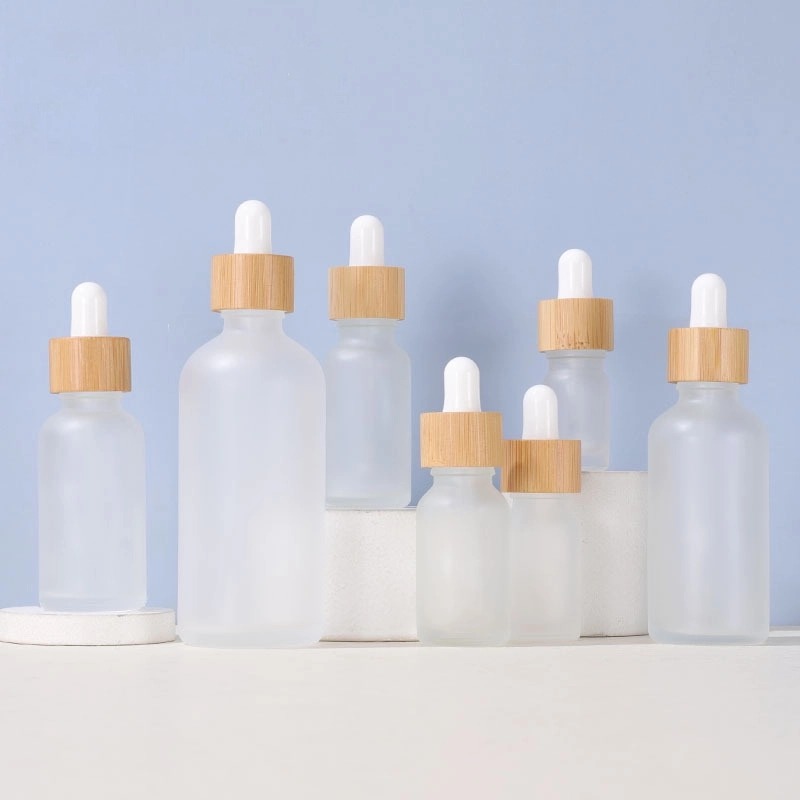
Frosted Glass Dropper Bottle
-
- Craftsmanship and Texture: Processes such as sandblasting, acid etching, or chemical frosting are applied to the inner or outer walls of the bottle. This creates diffuse light reflection, resulting in a refined, uniform matte finish.
- Practical Advantages: The frosted surface resists fingerprints and sweat. Additionally, the increased surface friction ensures a secure grip, making the bottle less likely to slip during handling.
- Light-Shielding and Preservation: The semi-transparent material effectively blocks ultraviolet and visible light, providing physical light protection for light-sensitive ingredients. This minimizes the risk of discoloration or loss of potency and extends the product’s shelf life after opening.
- Versatility and Styling: The bottle surface is suitable for screen-printed logos, hot stamping, matte labeling, or laser engraving, and pairs exceptionally well with eco-friendly elements like bamboo lids and wooden rings. The natural grain of the wooden ring contrasts beautifully with the soft, hazy texture of the matte glass—creating a “soft-meets-warm” aesthetic that reinforces a brand narrative of sustainable fashion—while the detachable wooden ring facilitates easy recycling and sorting.
Clear Glass Dropper Bottle
-
- Craftsmanship and Texture: Made from highly transparent soda-lime or borosilicate glass without additional surface treatments, the bottle features a classic, timeless, and minimalist aesthetic.
- Visibility: Consumers can clearly see the serum—checking for color uniformity, sedimentation, or separation—without opening the bottle, which fosters confidence in the formula. Additionally, the transparent body allows users to easily monitor the remaining product, prompting timely repurchases and enhancing user retention.
- Considerations: Due to high light transmission, transparent bottles offer virtually no protection against light exposure, which can accelerate the oxidation of light-sensitive ingredients. Consequently, supplementary protection—such as an outer carton, light-blocking inner liner, or dark-colored sleeve—is usually required, thereby increasing packaging costs and logistics volume to some extent.
🌱 Cost and Customization Comparison
Frosted Glass Dropper Bottle
-
- Production Costs: Achieving a frosted finish requires additional processing steps—such as sandblasting, acid etching, or chemical frosting—and demands higher-quality glass raw materials and superior surface uniformity; consequently, the defect rate is slightly higher compared to clear bottles. Costs increase further if custom-colored glass or dual-sided (inner and outer) frosting techniques are employed.
- Customization Potential: The bottle surface offers excellent adhesion and a matte base, making it ideal for intricate secondary processing, such as screen printing, hot stamping (gold or silver), laser engraving, and color spraying.
- Differentiation Value: The unique tactile and visual qualities of a frosted bottle create a distinctive brand impression, allowing the product to stand out amidst the homogeneity of retail shelves when combined with custom finishing techniques.
Clear Glass Dropper Bottle
-
- Production Costs: No surface treatment is required; the process offers high yields and a high degree of standardization, resulting in significantly lower per-unit costs and distinct price advantages for bulk procurement.
- Customization Options: Supports various printing and labeling techniques—such as screen printing, self-adhesive labeling, hot stamping (gold/silver), and acid etching—though the visual results differ slightly from other methods.
- Export Advantages: Transparent glass bottles comply with most international standards for pharmaceutical- and food-grade glass. The absence of additional surface treatments reduces the risk of friction-induced scratches during transit, while standardized packaging dimensions facilitate bulk exports and overseas warehousing.
🌱 How to Choose the Right Glass Dropper Bottle?
1. Based on Brand Positioning and Visual Tone
-
- Frosted glass dropper bottles, combined with customized finishes, quickly establish a professional and premium first impression.
- Clear glass dropper bottles align better with an image of authenticity and purity, allowing consumers to see the product’s true color directly.
2. Based on Product Formula and Stability Requirements
-
- Formulas containing light-sensitive ingredients: Frosted bottles—or their dark-tinted counterparts (such as amber or cobalt blue frosted glass)—are the priority choice. Their semi-transparency provides physical light protection, extending the active life of the formula and reducing the risk of discoloration or degradation.
- Ingredient color: Clear bottles allow the product’s hue to serve as a natural visual advertisement, reinforcing the concept of “visible freshness.” However, light-blocking outer packaging is required, and instructions should specify “store away from light.”
- Viscous textures or formulas with suspended particles: Clear bottles better showcase fluidity and suspension effects, enhancing visual appeal; frosted bottles may obscure these visual details and are therefore less suitable.
3. Based on Budget, Scale, and Sales Channels
-
- Startups / Small-batch product testing / Cross-border e-commerce: It is recommended to start with clear bottles and adhesive labels; this approach offers low minimum order quantities (MOQs), short lead times, and manageable costs, facilitating rapid iteration. To create differentiation, focus on details like the cap or dropper assembly (e.g., bamboo caps with wooden collars).
- Mid-to-large-scale brands / Flagship products / Offline retail counters: Frosted bottles combined with extensive customization (such as screen printing, hot stamping, and wooden collars) better support premium retail pricing and a high-quality visual presence on the shelf. In offline channels, consumers can physically experience the textures of the frosted glass and wood, often resulting in higher conversion rates compared to online-only displays.
🌱 Conclusion
There is no absolute “better” or “worse” choice between frosted and clear glass dropper bottles; it is simply a matter of finding the right fit.
By prioritizing the consumer perspective, upholding product safety as a non-negotiable baseline, and keeping long-term brand development in mind, you can identify the dropper bottle that best aligns with your needs. Whenever possible, validating your choice through small-scale prototyping and user testing can yield surprisingly positive results—often far more effectively than relying solely on rational analysis. Selecting the right packaging is akin to choosing the right opening line for your conversation with consumers: make it both authentic and compelling.
Last Updated: 2026/07/08

 English
  Italian