
 Italiano
 Português
 Amazon
 Ebay
Ebay
Ampoule Neck Types Guide: Tall, Narrow, Easy-Break
♻️ Introduction
Ampoule Bottle, as a high-precision glass container for pharmaceutical packaging, has become the preferred packaging solution for injections, vaccines, biologicals and high-end flavors and fragrances due to its aseptic sealing and chemical stability. In the pharmaceutical industry, medical laboratories and perfume manufacturing, ampoules of different sizes are completely sealed from outside contamination by nitrogen filling and flame sealing processes, ensuring the long-term preservation of the contents.
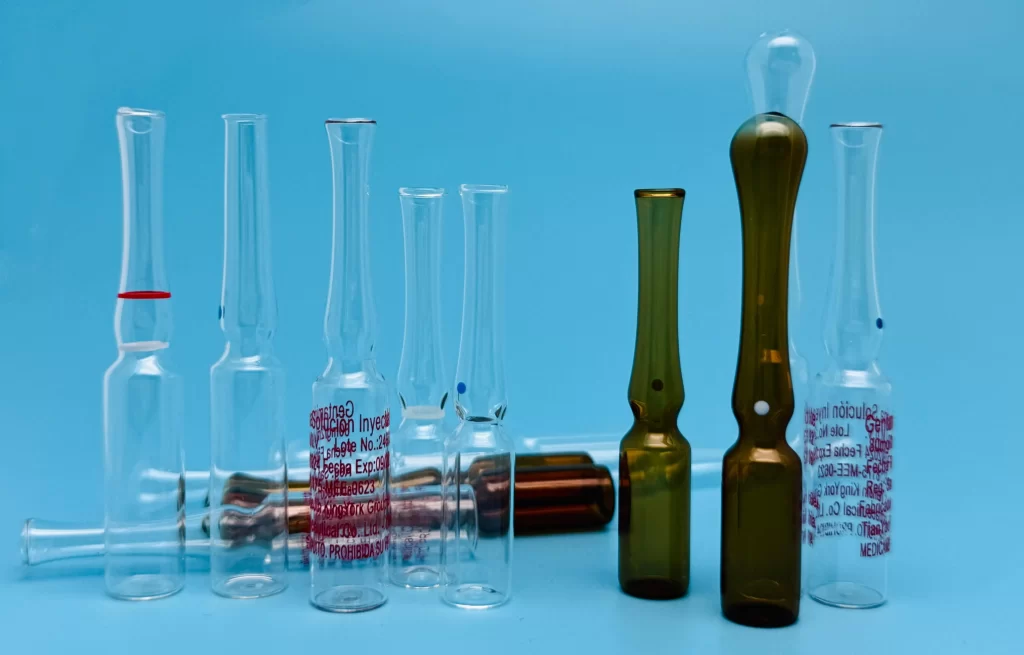
The neck design of an ampoule directly determines three key properties: ease of opening, filling efficiency, and seal integrity. In this article, we will analyze the three mainstream neck designs of pharmaceutical-grade ampoules – high neck, narrow mouth, and easy-folding seal. Through this article, we will grasp the impact of different neck structures on the stability and production yield of pharmaceutical products, so as to achieve the best balance between cost control and compliance requirements.
♻️ Tall Neck Ampoules
1. Structural features: optimized ergonomics and mechanical adaptation
High-necked ampoules with extended necks feature:
-
- Extended necks (≥20 mm) provide better handhold stability, especially for micropipetting and precise dispensing in the laboratory.
- Smooth transition curves to reduce stress concentration and the risk of glass breakage in case of breakage.
- Standardized scoring ring, adapted to automatic ampoule openers, ensures an even distribution of the breaking force.
2. Scenarios: high-precision medical and laboratory applications
The high neck design excels in the following scenarios:
-
- Laboratory analysis: e.g. HPLC sample preparation, standard solution dispensing, where contamination and volatilization losses need to be avoided.
- Medical injections: for small dose injections, easy for healthcare professionals to accurately extract medication.
- Manual operation environment: Extended neck provides better grip space, reduces hand shading and improves operation efficiency inside the biosafety cabinet.
3. Core advantages and precautions for use
✅ Core Advantages
-
- More Stable Breaking Performance: Extended neck design provides more uniform breaking force distribution, reduces glass spatter, and complies with USP<1> standard for injectable packaging.
- Compatible with automated equipment: Can be integrated with ampoule breaking pliers or fully automated dispensing systems to improve the efficiency of pharmaceutical production lines.
- Anti-slip design: Some of the high neck ampoules have frosted necks to enhance anti-slip grip.
⚠️ Precautions for Use
-
- Force must be applied along the point of the indentation: incorrect fracturing may result in irregular splitting, increasing the risk of contamination or cuts.
- Avoid excessive squeezing: high-necked ampoules are still thin-walled glass containers and mechanical shocks may lead to lateral rupture.
- Storage recommendations: Long-term storage requires protection from moisture than Guiyang, some sensitive drugs need to be matched but its filling to enhance stability.
♻️ Narrow Neck Ampoules
1. Structural features: fine design for optimized sealing and flow control
Narrow-necked ampoules are made with small bottle diameters (usually ≤6mm ID), and their core structural features include:
-
- Fine-necked design: reduces the area exposed to liquids and reduces the risk of oxidation and volatilization, especially suitable for readily degradable ingredients.
- Highly accurate drop control: the narrow mouth structure naturally restricts the flow rate, making it suitable for experimental or pharmaceutical processes where drop-by-drop additions are required.
- Enhanced hermeticity: larger glass contact surface after fusion sealing provides higher airtightness compared to wide-mouth ampoules and complies with USP<660> standards for pharmaceutical glass containers.
2. Scenarios: ideal packaging for small quantities of high-value liquids
Narrow-necked ampoules are widely used in the following areas:
-
- Injectable preparations: Highly concentrated, small dosages of medicines to ensure precise drug delivery.
- Flavors and essential oils: Prevent volatile components from escaping and maintain aroma stability.
- Laboratory reagents: used for long-term storage of standard solutions, calibration solutions, to avoid the evaporation of trace solvents to affect the concentration.
3. Core advantages and precautions for use
✅ Core Advantages
-
- Ultra-strong sealing performance: low leakage rate after narrow mouth melt sealing, suitable for sensitive preparations stored in nitrogen.
- Precise dosage control: natural laminar flow during pouring reduces splashing and is suitable for micro pipetting.
- Reduced residue: The thin neck structure reduces wall loss and improves the utilization of high-value liquid.
⚠️ Precautions for Use
-
- Not suitable for rapid decanting: the narrow mouth design results in a slower flow rate, a wide mouth model is recommended for large volumes (>10ml) or high viscosity liquids.
- Special tools are required for opening: some narrow mouth ampoules need to be opened with fine grinding wheel cutter to avoid contamination of glass fragments due to violent breakage.
- Filling process requires high requirements: it is necessary to match the precision filling needle to prevent the liquid from adhering to the bottle mouth and affecting the quality of fusion sealing.
♻️ Easy-Break Ampoules
1. Structural features: user-friendly design optimizes the opening experience
The easy-folding and sealing ampoule adopts the pre-set break point technology, and its innovative structure includes:
-
- Single-point crease: laser/mechanical pre-sculpted V-shaped groove at the neck is a pork belly case drop.
- Visual guide design: color ring marking (identifies the break location by eye-catching colors such as red/blue/green; sandblasted ring (increases friction and prevents slippery hands from mishandling).
- Low residue fracture: special glass heat treatment process ensures flat fracture surface and reduces the risk of glass particles falling off.
2. Scenarios: efficient and safe medication administration environment
The design is optimized for the following scenarios: emergency medical care, home medical care, mobile diagnosis and treatment, and health care product dispensing.
3. Core advantages and key operational specifications
✅ Revolutionary Advantages
-
- 300% increase in opening efficiency: shorter handling time compared to traditional ampoules.
- Dual cut-resistant design: passivated fracture (in accordance with EN ISO 23908 puncture resistance standard), plastic protective sleeve as standard (optional)
♻️ How to Choose a Neck Design Based on Application Scenarios?
When choosing an ampoule neck type, the need for structural design varies greatly from one application scenario to another. Whether it is a pharmaceutical ampoule, a lab ampoule, or a fragrance/essential oil ampoule packaging, the following aspects need to be considered in a comprehensive manner:
1. Focused considerations for different applications
-
- Pharmaceutical ampoules: more emphasis is placed on sealing, anti-contamination performance and single-use safety, usually in favor of easy-folding and sealing ampoules, which are easy to open and seal quickly.
- Laboratory ampoules: require high precision liquid extraction and cross-contamination prevention, so narrow mouth ampoules are preferred for precise control of drip flow rate.
- Fragrances and essential oils: more concerned with appearance and user experience, high neck ampoules may be preferred to enhance visual aesthetics and handling comfort while maintaining a tight seal.
2. Operation mode and equipment compatibility
-
- Manual opening: Recommended neck type with OPC scoring, easy for users to break off directly without additional tools.
- Automated opening and sealing equipment: usually more compatible with high neck ampoules, convenient for robotic gripping and stable breakage, suitable for large scale production lines.
3. Matching of content properties to neck shape
-
- Highly viscous liquids: selecting narrow mouth ampoules will minimize spillage, but attention needs to be paid to filling speed.
- Highly active ingredients: It is recommended to use heat- and light-resistant ampoule materials, and with a neck design that facilitates quick sealing to minimize the exposure time of the contents.
- Photosensitive liquids: A combination of brown glass and a suitable neck seal can effectively extend shelf life.
🔴 Selection conclusion: When choosing an ampoule neck design, the application area, the mode of operation and the characteristics of the contents should be taken into account in order to achieve the best possible sealing, safety and use experience.
♻️ Conclusion
Although ampoules are small, the design of their neck structure has a direct impact on the stability of drugs, operational safety and production efficiency. The high neck type for precise control, the narrow mouth type for superior sealing, and the easy folding type for convenient opening have their own advantages and are suitable for different scenarios.
Brands and purchasing decision makers should go beyond the “price first” thinking and pay attention to structural details when selecting a model.
In the field of pharmaceuticals and scientific research, packaging innovation is as important as technological innovation. Structural optimization of ampoules – from chip-resistant breaks to smart tracking designs – is continuing to drive advances in medication safety and experimental precision. Choosing the most appropriate neck design is a deep commitment to product quality, user experience and industry standards.
Last Updated: 2025/08/11

 English
  Italian