
 Italiano
 Português
 Amazon
 Ebay
Ebay
The Science Behind Matte Black Glass for Light-Sensitive Serums
⚫️ Introduction
This article starts by explaining the molecular mechanism, dissecting how light destroys photosensitive ingredients, and comparing the light-blocking performance of different packaging materials to tell you why high-end photosensitive serums are collectively turning to light-proof packaging.
⚫️ Bond Breaking at the Molecular Level
Many people’s understanding of photodegradation is limited to “oxidation.” However, oxidation is merely the result; the essence of photodegradation is the photon-driven breaking of chemical bonds.
1. Direct Photooxidation
When skincare ingredient molecules absorb photons of a specific wavelength, electrons transition from the ground state to an excited state. The molecule in this high-energy state is extremely unstable and may undergo three fates: homolytic/heterolytic bond cleavage, energy transfer, or free radical generation.
The photoreaction of retinoids includes photoisomerization, photopolymerization, photooxidation, and direct photodegradation. These reactions depend on wavelength, dosage, matrix, and concentration—but as long as light exposure continues, the reaction occurs, only at a different rate.
2. Indirect Photooxidation
Trace amounts of photosensitizers in the product matrix absorb light energy and enter an excited state, then transfer energy or electrons to the target active ingredient. Peptides and plant extracts are particularly sensitive to this—their complex structures often lead to unpredictable degradation fragments that not only become ineffective but may also act as irritants.
3. Not Just Ultraviolet Light
A common misconception is that “only ultraviolet light is destructive.” The truth is:
-
- UVB (280-315nm): Highest energy, sufficient to directly break the C-C or C-O bonds of most organic molecules;
- UVA (315-400nm): Slightly lower energy, but with extremely strong penetrating power, capable of penetrating ordinary transparent glass and plastic, reaching deep into the product’s interior;
- Visible light (400-700nm): The blue light band (400-450nm) has enough energy to excite many photosensitive components, especially molecules containing conjugated double bonds.
This means that even if your product avoids direct sunlight, photodegradation is still occurring when exposed to indoor lighting, mobile phone screen light, or reflected sunlight.
⚫️ Comparison of Packaging Light-blocking Performance
Packaging glass of different colors and processes exhibits vastly different light-blocking capabilities.
1. Clear Glass vs. Clear Plastic
Ordinary clear soda-lime glass blocks only about 16% of ultraviolet light and is almost completely transparent to visible light.
Clear PET plastic is in an even worse situation—besides being translucent, it is also permeable to air; oxygen molecules can slowly penetrate the plastic walls, accelerating degradation from both sides.
2. Amber Glass
Amber (brown) glass is the “gold standard” in the pharmaceutical and skincare industries. It blocks approximately 99% of ultraviolet light with wavelengths below 450nm, as well as most blue light. For general essential oils and ordinary concentrations of active ingredients, amber glass is adequate. However, its weakness lies in its limited blocking of high-energy wavelengths (450-500nm) in the visible light spectrum. Furthermore, the coloring of amber glass primarily comes from iron and sulfur compounds; if the coloring is uneven, “light leakage spots” may appear in certain areas.
3. Black Glass
Body-colored black glass (note: not surface coating) achieves extreme absorption of light across the entire wavelength range by adding a dark transition metal oxide composite system during the molten glass state. However, glossy black glass still has a slight weakness: when the surface is smooth, a small amount of light will bounce back and forth in the form of specular reflection, theoretically allowing even extremely weak photons to enter the bottle.
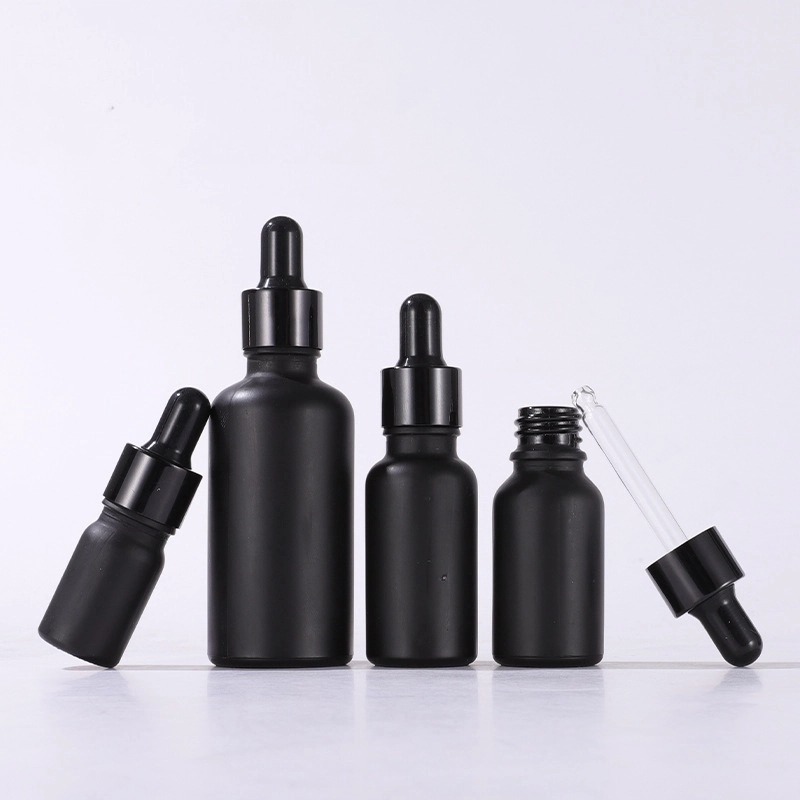
4. Matte Black Frosted Glass
A deep colorant is added during the glass melting stage, absorbing over 99.9% of incident light at the material level, including UVA, UVB, and all visible light wavelengths.
A microscopic rough structure is formed on the glass surface through acid etching or sandblasting processes, causing any residual light that manages to penetrate the first layer or enter through gaps to undergo diffuse reflection upon contact with the surface—photons are randomly bounced in various directions instead of penetrating in a straight line into the bottle.
⚫️ Why Must it be Glass?
Light blocking is only one aspect of protecting photosensitive ingredients. Chemical inertness and gas barrier properties truly determine shelf life.
1. Chemical Inertness
-
- Soda-lime glass and borosilicate glass are primarily composed of silicon dioxide (SiO₂), which is extremely chemically stable and reacts almost entirely with no skincare ingredients.
- PET plastics may release trace amounts of acetaldehyde; HDPE and LDPE have oil-absorbing properties; plasticizers in some plastics may migrate into the product.
2. Gas Barrier Properties
Oxygen is the second leading cause of bioactivity after light. Glass has an almost zero oxygen transmittance (OTR), while plastics have an OTR several orders of magnitude higher. Even the highest quality light-blocking plastics cannot compare to glass in terms of gas barrier properties.
⚫️ Conclusion
The matte black frosted glass isn’t a marketing gimmick; it’s the optimal engineering solution validated through cross-validation of materials science, photochemistry, and formula stability. It uses its inherent coloring to absorb photons at the molecular level, its frosted surface to scatter residual light, the chemical inertness of glass to prevent catalytic reactions, and its dense structure to block oxygen permeation. This quadruple protection is precisely the bottom line for the survival of photosensitive active ingredients from the production line to the consumer’s vanity.
The next time you pick up a bottle of high-concentration serum in a matte black frosted glass bottle, you’ll see more than just a sophisticated design—you’ll see the brand’s respect for the laws of photochemistry and the guarantee of the survival of every active molecule in that serum.
Last Updated: 2026/07/20

 English
  Italian