
 Italiano
 Português
 Amazon
 Ebay
Ebay
How Aluminum Rings Provide Zero-Evaporation Sealing?
🔔 Introduction
In the fields of essential oils, fragrances, and pharmaceutical solvents, liquid evaporation loss is a long-underestimated profit black hole. Many brands invest heavily in formulation and marketing, neglecting the fact that liquids disappear in ways invisible to the naked eye throughout the entire lifecycle, from bottling to opening.
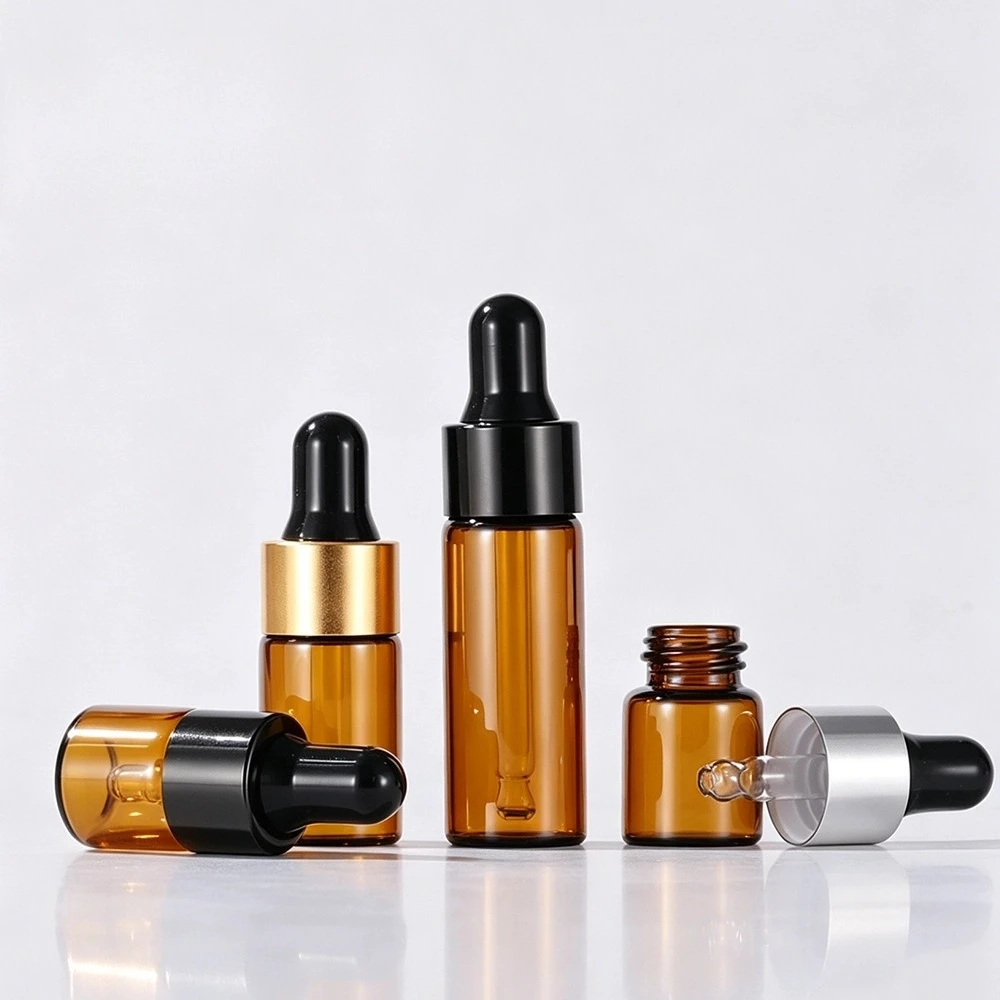
This article will delve into several dimensions to dissect how anodized aluminum ring glass dropper bottles achieve truly “near-zero evaporation” while maintaining consistent sealing reliability across various capacity specifications.
🔔 Protection of anodic oxide films
If the glass bottle is the container for storing liquid, then the oxide film on the anodized aluminum screw cap is the first and insurmountable line of defense protecting the bottle opening.
1. What is Anodizing?
Anodizing is an electrochemical conversion process. An aluminum threaded cap is immersed in an electrolyte and an electric current is passed through it, preventing a controlled oxidation reaction in the aluminum and allowing an aluminum oxide layer to grow in situ. This layer is sufficient to resist daily assembly friction and solvent corrosion.
2. How Does Sealing Ensure “Absolute Density”?
The anodized film is actually porous in its initial formation stage. The key lies in the sealing process:
-
- Oxygen molecules, water molecules, and most volatile organic molecules are physically intercepted upon encountering the dense barrier. This is the core of the sealing principle of anodized aluminum.
3. Comparative Advantages: Ordinary Aluminum Caps vs. Electroplated Aluminum Caps and Anodized Aluminum Caps
-
- Ordinary Aluminum Caps: The surface has a naturally loose oxide film, which is uneven and defective. Pure aluminum is also relatively soft, making the threads prone to deformation and gaps when screwed on.
- Electroplated Aluminum Caps: The plating layer is only mechanically bonded to the substrate, posing a risk of interface peeling. If the plating cracks or partially peels off, organic matter will volatilize.
- Anodized Aluminum Caps: The oxide layer is metallurgically bonded to the substrate, with no interface and no possibility of peeling. Even if the surface suffers minor scratches, the dense structure of the oxide layer itself can still block leakage paths, and a new oxide passivation layer can naturally form at the scratched area.
Lorem ipsum dolor sit amet...
This section will delve into how threaded sealing interference fits construct a second, insurmountable line of defense for anodized aluminum ring glass droppers.
1. What is an Interference Fit?
For precision packaging, the core of the leak-proof design for glass droppers lies in the interference fit—the internal thread of the aluminum cap is slightly smaller than the external thread of the glass bottle opening. When screwed on, the aluminum cap thread undergoes elastic deformation, continuously applying pressure outwards, generating a constant radial sealing pressure on the thread contact surface.
2. The “Defeat” of Plastic Caps
Polymer plastic materials relax under continuous pressure, accumulating damage with each opening and closing. The coefficient of thermal expansion of plastic is much higher than that of metal, while anodized aluminum caps maintain their initial torque after tightening.
3. Dual Protection
Many aluminum caps incorporate PTFE gaskets to enhance the end-face seal, but these gaskets are auxiliary, not core. Under prolonged pressure, both gaskets undergo permanent compression deformation, and high temperatures or contact with solvents accelerate aging, gradually diminishing the end-face seal.
The inherent hard metal seal of the anodized threads functions independently, forming a redundant sealing system.
🔔 Synchronous expansion under temperature fluctuations
Under temperature differences, glass and aluminum expand at different rates; if not handled properly, the seal becomes ineffective.
The linear expansion coefficient of glass is approximately 3.2 × 10⁻⁶/°C, remaining almost unchanged with temperature changes; while anodized aluminum has a coefficient of approximately 23 × 10⁻⁶/°C, seven times that of glass, making it very “active.” When heated, the aluminum cap expands much more than the glass bottle opening, and when cooled, it contracts much faster. With a standard thread design, at high temperatures, the aluminum cap becomes “loosened,” leading to increased gaps; at low temperatures, the aluminum cap “locks” the bottle opening, potentially even causing the glass to crack. How can these two vastly different materials be made to “synchronize” their expansion? The answer lies in the thread angle.
When the temperature rises, the radial expansion of the aluminum cap is greater than that of the glass bottle opening. If the thread angle is too gentle, the inner diameter of the aluminum cap will quickly move away from the bottle opening after expansion, causing a sharp drop in radial sealing pressure. The 60° tooth angle converts part of the radial expansion of the aluminum cap into axial compressive force—the aluminum cap doesn’t simply expand outwards, but simultaneously presses downwards along the 60° tooth angle, thus re-converting the increase in thermal expansion into sealing pressure on the contact surface.
Engineering doesn’t eliminate contradictions, but rather utilizes them. The inherent disadvantage of the different expansion coefficients of glass and aluminum is transformed into an acquired advantage of continuous locking under temperature differences through the precise design of the 60° tooth angle.
🔔 Buying Guide
As a purchasing decision-maker or brand owner, how do you select products with truly strong core capabilities from among numerous suppliers?
Sealing Quality
The density of different sealing processes varies significantly:
-
- The simplest room-temperature sealing (cold sealing) has the lowest cost, but leaves more pores in the film layer, allowing gas molecules to slowly permeate;
- Boiling water sealing or nickel salt sealing is more effective, as the hydration reaction fully blocks the nanoscale micropores;
- High-temperature steam sealing is considered the optimal solution, achieving a sealing rate of over 99% and completely densifying the oxide layer.
Gasket Material
-
- Although the metal hard seal of the anodized thread itself constitutes the core protection, in practical applications, the inner gasket is still recommended as a sealing layer to improve reliability.
Supplementary Examination Dimensions
The following two points should also be noted:
-
- First, ensure uniformity of appearance. High-quality anodized films have uniform color and are free from surface defects such as white spots, flow marks, or black spots.
- Second, ensure batch consistency. Suppliers should provide dimensional inspection data for three consecutive batches to ensure that mass production accuracy is consistent with the samples.
🔔 Conclusion
“Zero volatility” is never achieved by relying on a single component. The sealing reliability of anodized aluminum ring glass droppers stems from the synergy of three lines of defense; these three elements are interdependent and indispensable.
Using the three-line defense framework described in this article as your technical evaluation tool, and making product selection decisions based on engineering facts, is the most enduring way to protect brand quality.
Last Updated: 2026/07/13

 English
  Italian